| Mobile |
Mobile Module: 5G Sub-6 GHz SA, NSA (2.4, 3.4Gbps DL (4x4 MIMO) / 900, 550Mbps UL (2x2 MIMO)); 4G LTE: DL Cat 19 1.6Gbps (4x4 MIMO), UL Cat 18 200Mbps; 3G 42 Mbps (DL) / 5.76 Mbps (UL)
3GPP Release: Release 16
eSIM: Consumer type eSIM, profile download and removal (up to 7 profiles)
SIM Switch: Dual SIM cards and eSIM, auto-switch cases: weak signal, data limit, SMS limit, roaming, no network, network denied, data connection fail
Status: IMSI, ICCID, operator, operator state, data connection state, network type, CA indicator, bandwidth, connected band, signal strength (RSSI), SINR, RSRP, RSRQ, EC/IO, RSCP, data sent/received, LAC, TAC, cell ID, ARFCN, UARFCN, EARFCN, MCC, and MNC
SMS: SMS status, SMS configuration, EMAIL to SMS, SMS to EMAIL, SMS to HTTP, SMS to SMS, scheduled SMS, SMS autoreply, SMPP
USSD: Supports sending and reading Unstructured Supplementary Service Data messages
Block/Allow List: Operator block/allow list (by country or separate operators)
Multiple PDN: Possibility to use different PDNs for multiple network access and services
Band Management: Band lock, Used band status display
SIM Idle Protection Service: Configurable periodic switch to unused SIM to prevent blocking
SIM PIN Code Management: Setting, changing, or disabling SIM card's PIN
APN: Auto APN
Bridge: Direct connection (bridge) between mobile ISP and device on LAN
Passthrough: Router assigns its mobile WAN IP address to another device on LAN
Framed Routing: Support an IP network behind 5G UE |
| Wireless |
Wireless Mode: 802.11b/g/n/ac Wave 2 (Wi-Fi 5) with data transmission rates up to 867 Mbps (Dual Band, MU-MIMO)
Wi-Fi Security: WPA2-Enterprise: PEAP, WPA2-PSK, WPA-EAP, WPA-PSK, WPA3-SAE, WPA3-EAP, OWE; AES-CCMP, TKIP, Auto-cipher modes, client separation, EAP-TLS with PKCS#12 certificates, disable auto-reconnect, 802.11w Protected Management Frames (PMF)
SSID/ESSID: SSID stealth mode and access control based on MAC address
Wi-Fi Users: Up to 150 simultaneous connections
Wireless Connectivity Features: Wireless mesh (802.11s), fast roaming (802.11r), Relayd, BSS transition management (802.11v), radio resource measurement (802.11k)
Wireless MAC Filter: Allowlist, blocklist
Wireless QR Code Generator: Auto-enter network without login info upon scan
TravelMate: Forward Wi-Fi hotspot landing page to a subsequent connected device |
| Ethernet |
WAN: 1 x WAN port 10/100/1000 Mbps, compliance with IEEE 802.3, IEEE 802.3u, 802.3az standards, supports auto MDI/MDIX crossover
LAN: 3 x LAN ports, 10/100/1000 Mbps, compliance with IEEE 802.3, IEEE 802.3u, 802.3az standards, supports auto MDI/MDIX crossover |
| Network |
Routing: Static routing, Dynamic routing (BGP, OSPF v2, RIP v1/v2, EIGRP, NHRP), Policy-based routing
Network Protocols: TCP, UDP, IPv4, IPv6, ICMP, NTP, DNS, HTTP, HTTPS, SFTP, FTP, SMTP, SSL/TLS, ARP, VRRP, PPP, PPPoE, UPNP, SSH, DHCP, Telnet, SMPP, SNMP, MQTT, Wake On Lan (WOL), VXLAN
VoIP Passthrough Support: H.323 and SIP-alg protocol NAT helpers
Connection Monitoring: Ping Reboot, Wget Reboot, Periodic Reboot, LCP and ICMP for link inspection
Firewall: Port forward, traffic rules, custom rules, TTL target customisation
Firewall Status Page: View all Firewall statistics, rules, and rule counters
Ports Management: View device ports, enable/disable, auto-configuration, change transmission speed
Network Topology: Visual representation of network connections
Hotspot: Captive portal, internal/external Radius server, Radius MAC authentication, SMS authorisation, SSO authentication, internal/external landing page, walled garden, user scripts, URL parameters, user groups, individual user or group limitations, user management, 9 default customisable themes and optionality to upload and download customised hotspot themes
Hotspot 2.0: Wi-Fi standard for seamless, secure, and automatic connection to trusted wireless networks
DHCP: Static and dynamic IP allocation, DHCP relay, DHCP server configuration, status, static leases: MAC with wildcards
QoS / Smart Queue Management (SQM): Traffic priority queuing by source/destination, service, protocol or port, WMM, 802.11e
DDNS: Supported >25 service providers, others configurable manually
DNS over HTTPS: Secure DNS resolution by routing DNS queries over HTTPS
Network Backup: Wi-Fi WAN, Mobile, VRRP, Wired options, each for automatic Failover
Load Balancing: Balance Internet traffic over multiple WAN connections
SSHFS: Possibility to mount remote file system via SSH protocol
VRF Support: Initial virtual routing and forwarding (VRF) support
Traffic Management: Real-time monitoring, wireless signal charts, traffic usage history |
| Security |
Authentication: Pre-shared key, digital certificates, X.509 certificates, TACACS+, Internal & External RADIUS users authentication, IP & login attempts block, time-based login blocking, built-in random password generator
Firewall: Preconfigured firewall rules via WebUI, unlimited firewall configuration via CLI, DMZ, NAT, NAT-T, NAT64
Attack Prevention: DDOS prevention (SYN flood protection, SSH attack prevention, HTTP/HTTPS attack prevention), port scan prevention (SYN-FIN, SYN-RST, X-mas, NULL flags, FIN scan attacks)
VLAN: Port and tag-based VLAN separation
Mobile Quota Control: Mobile data limit, customizable period, start time, warning limit, phone number
WEB Filter: Blacklist for blocking unwanted websites, Whitelist for specifying allowed sites only
Access Control: Flexible access control of SSH, Web interface, CLI and Telnet
SSL Certificate Generation: Let's Encrypt and SCEP certificate generation methods |
| VPN |
OpenVPN: Multiple clients and a server simultaneously, 27 encryption methods
OpenVPN Encryption: DES-CBC 64, RC2-CBC 128, DES-EDE-CBC 128, DES-EDE3-CBC 192, DESX-CBC 192, BF-CBC 128, RC2-40-CBC 40, CAST5-CBC 128, RC2-64-CBC 64, AES-128-CBC 128, AES-128-CFB 128, AES-128-CFB1 128, AES-128-CFB8 128, AES-128-OFB 128, AES-128-GCM 128, AES-192-CFB 192, AES-192-CFB1 192, AES-192-CFB8 192, AES-192-OFB 192, AES-192-CBC 192, AES-192-GCM 192, AES-256-GCM 256, AES-256-CFB 256, AES-256-CFB1 256, AES-256-CFB8 256, AES-256-OFB 256, AES-256-CBC 256
IPsec: XFRM, IKEv1, IKEv2, with 14 encryption methods (3DES, DES, AES128, AES192, AES256, AES128GCM8, AES192GCM8, AES256GCM8, AES128GCM12, AES192GCM12, AES256GCM12, AES128GCM16, AES192GCM16, AES256GCM16)
GRE: GRE tunnel, GRE tunnel over IPsec support
PPTP, L2TP: Client/Server instances simultaneously, L2TPv3, L2TP over IPsec support
Stunnel: Proxy for adding TLS encryption
DMVPN: Method for building scalable IPsec VPNs, Phase 2 and Phase 3 and Dual Hub support
SSTP: SSTP client instance support
ZeroTier: ZeroTier VPN client support
WireGuard: WireGuard VPN client and server support
Tinc: Tinc offers encryption, authentication and compression in its tunnels. Client and server support.
Tailscale: Speed, stability, and simplicity over traditional VPNs. Encrypted point-to-point connections using WireGuard |
| OPC UA |
Supported Modes: Client, Server
Supported Connection Types: TCP |
| MODBUS |
Supported Modes: Server, Client
Supported Connection Types: TCP, USB
Custom Registers: MODBUS TCP custom register block requests (read/write to file, extend MODBUS TCP Client)
Supported Data Formats: 8-bit: INT, UINT; 16-bit: INT, UINT (MSB or LSB first); 32-bit: float, INT, UINT (ABCD (big-endian), DCBA (little-endian), CDAB, BADC), HEX, ASCII |
| DATA TO SERVER |
Protocol: HTTP(S), MQTT, Azure MQTT
Data to Server: Extract parameters from multiple sources and protocols, send to a single server; Custom LUA scripting |
| MQTT Gateway |
Modbus MQTT Gateway: Allows sending commands and receiving data from MODBUS Server through MQTT broker |
| DNP3 |
Supported Modes: Station, Outstation
Supported Connection: TCP, USB |
| DLMS/COSEM |
DLMS Support: DLMS - standard protocol for utility meter data exchange
Supported Modes: Client
Supported Connection Types: TCP |
| API |
Teltonika Networks Web API: Set of configurable API endpoints to retrieve or change data |
| Monitoring & Management |
WEB UI: HTTP/HTTPS, status, configuration, FW update, CLI, troubleshoot, multiple event log servers, firmware update availability notifications, event log, system log, kernel log, Internet status
FOTA: Firmware update from server, automatic notification
SSH: SSH (v1, v2)
SMS: SMS status, SMS configuration
Call: Reboot, Status, Mobile data on/off, Output on/off, answer/hang-up with a timer, Wi-Fi on/off
Email: Receive email message status alerts of various services
TR-069: OpenACS, EasyCwmp, ACSLite, tGem, LibreACS, GenieACS, FreeACS, LibCWMP, Friendly tech, AVSystem
MQTT: MQTT Broker, MQTT publisher
SNMP: SNMP (v1, v2, v3), SNMP Trap, Brute force protection
JSON-RPC: Management API over HTTP/HTTPS
RMS: Teltonika Remote Management System (RMS) |
| IoT Platforms |
ThingWorx: Monitoring WAN Type, WAN IP, Mobile Operator Name, Mobile Signal Strength, Mobile Network Type
Cumulocity - Cloud of Things: Monitoring Device Model, Revision and Serial Number, WAN Type and IP, Mobile Cell ID, ICCID, IMEI, Connection Type, Operator, Signal Strength. Reboot and firmware upgrade actions.
Azure IoT Hub: Configurable with Data to Server to send parameters to the cloud. Direct method support for RutOS API calls. Plug and Play integration with Device Provisioning Service for zero-touch provisioning.
AWS IoT Core: Utility to interact with AWS cloud platform. Jobs Support: Call the device's API using AWS Jobs functionality |
| System Characteristics |
CPU: MediaTek, Dual-Core, 880 MHz, MIPS1004Kc
RAM: 256 MB, DDR3
FLASH Storage: 16 MB serial NOR flash, 256 MB serial NAND flash |
| Firmware / Configuration |
WEB UI: Update FW from file, check FW on server, configuration profiles, configuration backup
FOTA: Update FW
RMS: Update FW/configuration for multiple devices at once with Teltonika RMS
Keep Settings: Update FW without losing current configuration
Factory Settings Reset: Full factory reset restores all system settings |
| FIRMWARE CUSTOMISATION |
Operating System: RutOS (OpenWrt based Linux OS)
Supported Languages: Busybox shell, Lua, C, C++, and Python, Java in Package manager
Development Tools: SDK package with build environment provided
GPL Customization: Create custom, branded firmware and web page application
Package Manager: Service used to install additional software |
| Location Tracking |
GNSS: GPS, GLONASS, BeiDou, Galileo and QZSS
Coordinates: GNSS coordinates via WebUI, SMS, TAVL, RMS
NMEA: NMEA 0183
NTRIP: NTRIP protocol (Networked Transport of RTCM via Internet Protocol)
Server Software: Supported server software TAVL, RMS
Geofencing: Configurable multiple geofence zones |
| USB |
Data Rate: USB 2.0
Applications: Samba share, USB-to-serial
External Devices: Possibility to connect external HDD, flash drive, additional modem, printer, USB-serial adapter
Storage Formats: FAT, FAT32, exFAT, NTFS (read-only), ext2, ext3, ext4 |
| Input / Output |
Input: 2 x Inputs for Ignition Detection and Low Battery
Events: Email, RMS, SMS
I/O Juggler: Allows setting I/O conditions to initiate events |
| SD CARD |
Physical Size: Micro SD (internal)
Applications: Samba share
Capacity: Up to 2 TB
Storage Formats: FAT32, NTFS, ext2, ext3, ext4 |
| Power |
Connector: M12 A code 4 pin male
Input Voltage Range: 9 - 50 VDC, reverse polarity protection, Overvoltage protection (70V), Surge protection >69 VDC 10us max
Power Consumption: Idle: < 5.5 W, Max: < 16 W |
| Physical Interfaces |
Ethernet: 4 x M12 X code 8-pin female ports, 10/100/1000 Mbps
I/O’s: 2 x Input (Ignition detection/Low battery)
Status LEDs: 4 x WAN type, 3 x Mobile connection type, 3 x Mobile connection strength, 6 x LAN status, 2 x WAN status, 1 x Power, 2 x 2.4G and 5G Wi-Fi
SIM: 2 x SIM slots (Mini SIM - 2FF), 1.8 V/3 V
Power: 1 x M12 A code 4-pin male connector
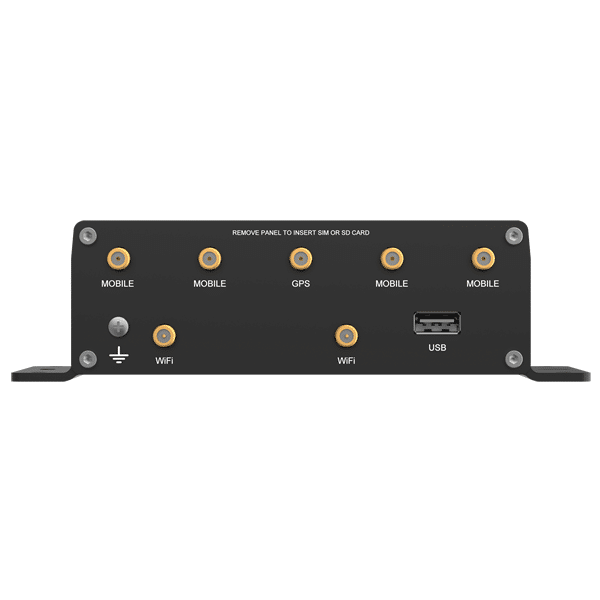
Antennas: 4 x SMA for Mobile, 2 x RP-SMA for Wi-Fi, 1 x SMA for GNNS
USB: 1 x USB A port for external devices
Reset: Reboot/User default reset/Factory reset button
Other: 1 x Grounding screw |
| Physical Specification |
Casing Material: Anodized aluminum housing and panels
Dimensions (W x H x D): 167 x 46.2 x 112.4 mm
Weight: 550 g
Mounting Options: Flat surface |
| Operating Environment |
Operating Temperature: -40 °C to 75 °C
Operating Humidity: 10% to 90% non-condensing
Ingress Protection Rating: IP30 |
| Regulatory & Type Approvals |
Regulatory: CE, UKCA, RCM, R-NZ, CB, EAC, UCRF, WEEE
Vehicle: E-mark, Railway |
| EMC Emissions & Immunity Standards |
EN 55032:2015+ A11:2020 + A1:2020
EN 55035:2017+A11:2020
EN 61000-3-3:2013+A1:2019+A2:2021
EN IEC 61000-3-2:2019+A1:2021
EN 301 489-1 V2.2.3
EN 301 489-3 V2.3.2
EN 301 489-17 V3.2.4
EN 301 489-52 V1.2.1
AS/NZS CISPR 32:2015+A1:2020
ESD: EN 61000-4-2:2009
Radiated Immunity: EN IEC 61000-4-3:2020
EFT: EN 61000-4-4:2012
Surge Immunity (AC Mains Power Port): EN 61000-4-5:2014+A1:2017
CS: EN 61000-4-6:2014
DIP: EN 61000-4-11:2020 |
| RF Standards |
EN 300 328 V2.2.2
EN 301 893 V2.1.1
EN 300 440 V2.2.1
EN 301 908-1 V15.2.1
EN 301 908-2 V13.1.1
EN 301 908-13 V13.2.1
EN 301 908-25 V15.1.1
AS/NZS 4268:2017+A1:2021
AS/CA S042.1:2022
AS/CA S042.4:2022
AS/CA S042.5:2022+A1:2022
FCC Part 22 |
| Safety Standards |
EN IEC 62311:2020
EN IEC 62368-1:2020+A11:2020
AS/NZS 2772.2:2016+A1:2018 |




Reviews
There are no reviews yet.